WRNUs kreativitetskalender 2025

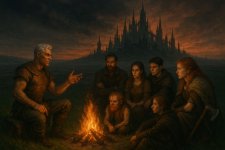
Nu är Waverider-expeditionen utanför den mystiska staden som kallas Nekropolis, där Velan berättar sin historia.

20251015_1027_Campfire Tales at Dusk_simple_compose_01k7kfkabretda26qzr8a54xzh.jpg

By midday, Necropolis shimmered like a mirage.

From afar it seemed a city carved from smoke and glass, its towers still sharp though no hand had touched them in a thousand years. The air above it trembled with heat, yet no wind stirred its streets. Nothing moved. Not even birds. Between the crew and the city stretched a line of dead grass, perfect, circular, unbroken. Beyond it, the soil was gray and sterile, as if the world itself refused to remember life there.

The Waverider’s crew made camp just outside that line. None spoke much as they ate. Even the fire seemed reluctant to burn too bright, the smoke rising thin and fast toward the pale sky. Captain Virellus sat staring at the ruins, his face unreadable. The others watched too, Rahim polishing a knife he wasn’t using, Selene lost in the patterns of ash.

When Velan spoke, his voice was low, as though he feared the city might hear.

“I’ve been here before,” he said.

The others looked up. His eyes were on the horizon, but unfocused, turned inward.

“Years ago,” he went on. “Before I ever saw the sea. I was a young mercenary then. The Empire paid well for runners, slave children mostly, quick and small. They’d send us to guard the edge, keep count, bring back what came out.”

He drew a long breath. “I led them in. Always just a little further each time.”

No one interrupted.

“They were just children,” he said. “Thin as reeds. Some had never seen the sun outside the slave pens. I’d march them in till I saw the towers rise close. Then I’d stop. I told myself I was keeping them safe. But I stayed behind because I was afraid.”

He stirred the sand with his boot. “One by one, they’d run back. Some carrying gold, some nothing at all. Fewer every day.”

He paused. The fire cracked softly.

“The last time, there were five. I remember their faces. The youngest couldn’t have been ten. We found a street lined with statues, faces eaten by time, hands all pointing west. I made them run ahead, just to the next corner, and wait for me there.”

He swallowed. “They didn’t come back.”

His voice was dry now, rasping. “I started to go after them, but the light was already wrong. The city bends distance. Turns minutes into hours. When I saw the sun touching the towers, I ran. I saw them run after me. I could hear their feet, I swear it.”

He lifted his eyes to the horizon. “I crossed the line just as the sun disappeared. Turned around… and they were gone. No sound. No shadow. Just gone.”

No one spoke. The wind shifted, carrying the faint smell of stone and dust from the city.

Velan stared into the fire. “I didn’t go back in. Not that day, not ever. Sold my blade, bought a berth on the next ship I found. Haven’t served the Empire since. Haven't been involved in slavery since.”

They sat in silence after that. The fire guttered, and the last light sank behind the Necropolis. The city loomed against the blood-red sky... vast, cold, and watching. Somewhere far within, something seemed to catch the fading light and return it, like an eye.

Minutes passed. Or hours. No one knew.

Then Otto the Dwarf cleared his throat.

“So why are we here?” he said at last. “This is crap. Let’s go back to the ship and drink.”

Velan blinked, and for the first time since he began speaking, he smiled, faintly, bitterly.

No one argued.

They packed their things in silence. As they turned toward the coast, the fire died behind them. And when the last ember went dark, the Necropolis was gone from sight, as if it had never been there at all.

Description

In the heart of the Great Empire lies the Necropolis, a vast, crumbling city of impossible scale and unknowable origin. It sprawls for leagues, its boundaries always cloaked in mist or shimmering heat haze, as though reality itself frays at its edges. No empire, kingdom, or scholar claims to have built it. It is not found in any of the historical texts. Even the oldest myths begin with its discovery, not its creation.

The Curse of Necropolis

The Necropolis is lifeless by day, quiet and still, its ancient buildings untouched by wind or weather, as though frozen in a moment before time itself began. But as the sun sinks below the horizon, a silence deeper than death takes hold, and the true nature of the city reveals itself.

Anyone caught within its borders after nightfall vanishes. Fires go out. Lanterns fail. Magic sputters. No screams are heard. Only silence. When light returns, the city is always unchanged, but the people are gone without trace, not even ashes left behind. Some claim that even shadows move against you, tearing the soul from the body. Others speak of invisible watchers, and cities beneath the city, where things older than gods whisper in languages never spoken by man.

The Treasures Within and the Runners

It was from this haunted ruin that the Great Empire drew its first blood-gold. The bones of the Empire’s greatness were built on the treasure hauled from the dead city. At first, the scavenging was safe, limited to the sunlit outer edges. Over time, desperate to grow richer, the Empire drove slaves deeper into the city. Few ever did come out, but the riches they carried were undeniable, jewels the size of fists, precious metals, abstract artifacts.

The city is a maze, always different, always similar, yet familiar in its monstrous scale. Some believe it watches those who enter. Experiments were conducted. Slaves were chained in place, surrounded by fire and torchlight. The lights died as the sun set. The next morning, nothing remained. No sign of struggle. No blood. Just absence.

Now, centuries later, the outer wards are empty and stripped. Only fools and glory-seekers venture inward. Still, the lure remains strong, for all believe the greatest treasures lie untouched near the heart, at the spire that looms like a black tooth over the ruined city. But no one has ever reached it and come back.
 
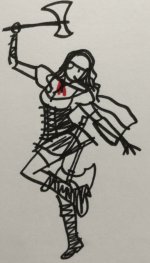
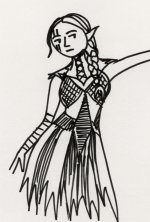
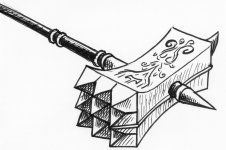
På gårdagens spelträff dog en av ungdomarnas rollpersoner, så hen ska fundera ut en ny över jullovet. Hen frågade efter ett släkte som inte behöver lika mycket sömn, så jag slängde ihop den här:
1000022408.jpg
Smedfödd
Kvarglömda reliker från en bortglömd civilisation eller besökare från en avlägsen framtid. Smedfödda vandrar jorden på jakt efter något förlorat.

Fördel. En smedfödd återfår sina hälsopoäng och förlorade besvärjelser efter fyra timmars vila.
 
Last edited:
Waverider-besättningen hälsar nu från Ssar'et, ett djupt djupt in i öknen. Se det som om Kung Arthur var en ödleman och Merlin en ödlekvinna, i öknen.

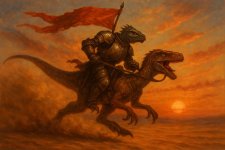
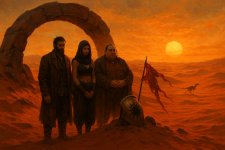
20250904_0800_Lizardman Desert Charge_simple_compose_01k49mxj7ee8a89ppwa7zv58ya.jpg20251021_1524_Desert Farewell_simple_compose_01k83ezvkyeyc8hrjfn488m8tg.jpg

The desert shimmered like a forge.

Solonex, Severin, and Kethra followed the dry riverbed until the cliffs of Ssar'et rose before them, black basalt and red stone, carved by time and pride. At the foot of a fallen arch stood a lone figure, motionless but alive. Bronze armor gleamed over dark green scales, etched with sigils that caught the sun. A raptor-beast crouched beside him, lean and terrible, quills rising with each breath.

The knight inclined his head. "Travelers. You walk unwatched ground."

"We mean no trespass," Solonex said.

"All ground is trespass without witness," the knight replied. His voice was low, rasped, patient. "Here stood the hold of Mistress Vethakka. Here, no longer."

Severin's voice came soft. "Your mistress?"

"She died six dawns past."

"My condolences," Severin said.

The knight touched the red banner beside him. "Accepted. I remain as the watch she no longer keeps."

Kethra's eyes narrowed. "You guard a grave alone?"

He turned slightly, showing the black sun engraved on his pauldron. "Order of the Black Sun. I vowed never to retreat."

The words hung heavy in the heat.

Then the wind shifted. Sand hissed. Shapes rose from the dunes - men in tattered veils, carrying curved blades. Raiders.

The knight moved first. His raptor screamed and lunged, claws flashing. The Zhorai's lance struck like lightning, bronze ringing on bone. Solonex joined him, sword sweeping low, cutting through a raider's legs. Kethra darted behind the raiders, her twin blades finding throats in silence. Severin did not fight. He stepped back, calm and watchful, ready to shout warning or bargain if the tide turned.

When it ended, the sand ran dark.

"You fought clean," the knight said, wiping blood from his blade. "Few do."

More figures appeared on the ridge, a second wave, too many this time.

"Come with us," Severin urged. "You've done your duty. You owe no one your death."

The knight looked toward the horizon. "A Black Sun does not retreat."

Severin looked at him, and for a heartbeat, wished he believed in something that much.

He turned to his raptor, resting a hand on its neck. "When I fall," he said quietly, "free Vek. Do not let him die beside me."

Karresh climbed into the saddle. The movement had the same tone as prayer. Vek hissed, quills high, then stilled as the weight settled, as if remembering an old song. The Zhorai lowered his lance. "Eternal Kings witness," he said softly, for himself, not for them.

The raiders charged. Bronze flashed. Sand boiled. From the rise, Solonex and Kethra watched the storm, bronze flashing, sand boiling, as the Zhorai and his mount became one. But a hooked blade slipped through a gap beneath the arm, and blood poured black on bronze.

Still, the knight did not fall.

He killed his killer, then turned his head toward the humans. "Now," he rasped.

Kethra was already there, slashing through the reins and ripping away the beast's bronze mask. "Go!"

The raptor hesitated, one heartbeat, no more, then bolted into the desert, a blur of gold and dust.

The knight sank to one knee, blood soaking the sand. "Map your world," he said, voice breaking. "Leave this place blank."

He died kneeling, sword before him like a shrine.

They buried him beneath the fallen arch. Severin set the red banner in the sand, its cloth whispering in the hot wind. For a long time, none spoke.

At last, Severin said, "Some vows are cages."

Kethra watched the horizon where the raptor had run. "And some cages are all they have left."

Solonex looked down at the grave, the black sun faintly visible through the dust. "Then may the desert keep him," he said.

From far off came a single, thin cry, a raptor's voice, fading into the wind. It sounded, for a moment, like mourning.
 
Dagens hälsning från Waverider-expeditionen, nu i sann Lucia-anda, med eld i håret och religiöst firande.

20250721_1102_Ritual at Sunrise_simple_compose_01k0p3cn1eehfa2dqy2m0ajwtp.jpg

The air in Sanctum Omros burned before it touched the skin. White walls. White streets. White-robed faithful walking in rows beneath a white sun. Even the shadows seemed afraid to linger.

Eira had seen battlefields, slaughter, famine, but never a place so clean, so empty of color that it felt holy in the wrong way.

They came ashore at midday: the Captain, Rahim, Severin, and her. The others stayed aboard, uneasy about the rumors. But supplies were needed, and the priests had granted them passage.

The streets were nearly silent. The only sound was the bell that tolled every few breaths, slow, rhythmic, final.

Then they heard the crowd.

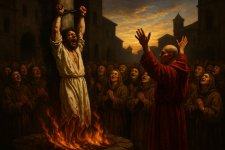
At first, Eira thought it was a festival. The sound had that kind of weight, the murmur of hundreds moving as one. But as they turned a corner, the smell hit her. Pitch. Smoke. Flesh.

The square was packed shoulder to shoulder. Thousands filled it, heads bowed toward a platform at the center. There, twelve people stood bound to iron stakes, men, women, children. Two families.

Priests in gray surrounded them, torches raised.

One of them cried out, voice booming across the square:

“They sang of false gods! They read unholy books! But Omros, in His mercy, welcomes them to His flame!”

The crowd answered in unison:

“The flame purifies. The pure shall burn brightest.”

Eira’s stomach turned. “They’re going to...”

The first torch touched kindling. Fire leapt.

The screams came only for a moment before the chanting drowned them. “The flame purifies. The pure shall burn brightest.”

The others watched, knowing what waited for them, and screamed.

She moved before she knew she’d moved, pushing through the press of bodies. Rahim followed, hand on his sword. But Severin’s voice stopped them, low, sharp, cutting through the chant.

“Look at their faces,” he said.

Eira froze.

They weren’t angry. They weren’t horrified. They were smiling. Mothers lifted their children so they could see better. Men wept openly, not in pity, but in joy. A woman beside her whispered prayers of gratitude, her hands trembling with ecstasy.

“This is faith to them,” Severin said quietly. “They think this is salvation.”

Rahim’s voice was rough. “They’re butchers.”

“Misled,” Severin replied. “But convinced. You could kill a hundred, a thousand, it wouldn’t matter. They’d die believing themselves righteous.”

Eira’s hand shook on the hilt of her blade. She wanted to move, to do something, but the weight of all those eyes, all that certainty, pressed down on her like heat from the sun.

"An army could kill them," Severin added, "but an army couldn't change how they think."

The Captain stepped forward, his face gray with ashen fury. Then he stopped. For a long time he stared at the fire, the first victim still squirming, jaw tight. When he turned away, his voice was hollow.

“Enough,” he said. “We leave. We’ll not come here again.”

They pushed through the crowd in silence. No one stopped them. No one even noticed. The faithful were still singing as the smoke rose higher, thin and white against the burning sky.

Back aboard the Waverider, the sea wind carried the smell of fire far out to them.

Eira leaned on the rail, watching the city gleam on the horizon, pure, blinding, untouched.

“They think that’s holiness,” she said softly. “They think they’re saved.”

Severin adjusted his gloves, eyes on the smoke. “No,” he said. “They think they’re right. It’s worse.”
 
Lucka 13: På luckan syns en glansig bild av ett Luciatåg. Bilden är uppenbart AI-genererad och innehåller flera lucior, deformerade ansikten och sammansmälta personer.

(uppdaterad version av bidrag till årets enbladsscenariotävling)

LUSSI BRUD

Översikt: Nutid. Rollpersonerna utreder en folkhögskolestudents försvinnande på en avskild ort i Bergslagen. Det visar sig att den eftersökta har utsetts till Lucia under folkhögskolans lussande. Rollpersonerna snubblar över traditionen på orten att vart 26:e år skicka Lucian till gruvhålet vid Rümmelgården, där varelsen Lussi väntar.

Uppdraget: av någon anledning ska rollpersonerna undersöka var Linnéa, en 22-årig folkhögskolestudent, blivit av. Linnéa går ett folkhögskoleprogram i en liten ort någonstans i Bergslagen. Rollpersonerna kan vara bekanta, släktingar eller vänner till Linnéa och hennes familj, eller externt kontaktade utredare. Rollpersonerna anländer till orten någon dag innan julafton.

Vad vet vanliga studenter på folkhögskolan: De flesta studenterna har åkt hem över jul, men några är kvar. De kan berätta att Linnéa utsågs till skolans Lucia (en tradition som de flesta tänkte var lite ocool för folkhögskolan, men som rektorn drivit igenom skulle genomföras just detta år). Efter lussande på det lokala ålderdomshemmet försvann Linnéa. De flesta tror att hon åkt hem till Stockholm (hon kanske har en kille där?)

Vad vet Linnéas rumskompis Maja: Maja ska alldeles strax åka hem till Örebro för julledighet, men kan berätta att hon inte sett Linnéa sedan 13:e december då hon först lussade i skolans matsal för att sedan bege sig till ålderdomshemmet. Maja är ovillig att svara på så många frågor och antar att Linnéa helt enkelt kommer vara tillbaka på internatet efter julledigheten. Om Maja pressas eller övertalas kan hon berätta att Linnéa haft problem med sitt långdistansförhållande, och att hon har pratat om att hon vill göra slut med Pelle som bor i Stockholm.

Vad vet resten av lussetåget: Linnéa lussade på ålderdomshemmet med framgång (även om de flesta tyckte det var lite töntigt med luciatåg var det också lite fint att se gamlingarnas glada ansikten). Efter ålderdomshemmet mötte Linnéa upp en äldre man som hon åkte iväg med i en gammal Volvo (”det kanske var hennes farfar?”). Ingen har sett henne sedan dess.

Vad vet rektorn Ann-Louise: Skolan brukar inte ägna sig åt Lucia-tåg, men Ann-Louise säger att hon tyckte det var en bra idé i år (”det är ju trots allt många som vill”). Ann-Louise säger sig inte sett Linnéa de senaste dagarna. Om hon pressas framkommer att det var 26 år sedan senaste gången ett lucia-tåg anordnades på orten, då på det numera nedlagda högstadiet, vars lokaler folkhögskolan numera använder.

Vad kan man få veta om skolan på orten: Det nedlagda högstadiet hette Bergsskolan och den sista rektorn på skolan var Jöns Fransson, som fortfarande bor på orten. Skolan byggdes på 1960-talet och ersatte den gamla folkskolan på orten.

Vad kan man få veta om Jöns Fransson: Jöns är pensionerad sedan flera år, och ses som en kuf på orten. Han bor i en liten lägenhet i ortens centrum sedan han förra året flyttade från ålderdomshemmet (på ålderdomshemmet kan man ta reda på att Ann-Louise är Jöns dotter och närmaste anhöriga). Han äger en veteranklassad Volvo. Frans lägenhet är helt tom om rollpersonerna undersöker den; den verkar inte användas alls.

Vad kan man få veta om äldre skolhistoria på orten: Om man gräver i rätt dokument (på internet eller på det lokala biblioteket – som inte har öppet under julhelgen, vilket kanske kan bemästras med list) får man veta att Bergsskolans första rektor hette Pär Fransson (far till Jöns Fransson). Pär var sonson till bygdens starke man Frans Rümmel – en framstående bergsman och kemist under slutet av 1800-talet. Rümmel öppnade den första folkskolan på bygden i början av 1900-talet för att tillse god utbildning för sina arbetares barn.

Vad kan man få veta om Lucia-traditionen på orten: Om man söker i lokala tidningar under en längre tid framkommer det att Lucia enbart har firats officiellt på orten var 26:e år. Vidare sökningar avslöjar att luciorna som utsetts under 1900-talet alla varit utomsockens flickor. Djupa sökningar visar att Frans Rümmel var den som introducerade Lucia-traditionen på 1890-talet.

Vad kan man få veta om Frans Rümmel: Frans Rümmel hade en större gård i bygdens utkant – Rümmelgården – där majoriteten av malmbrytningen utgick från. I en tidningsartikel från 1878 framkommer att en meteorit har slagit ned på Rümmelgården. Vetenskapsmän från Uppsala har varit på plats och tagit prover, men Rümmel har fått behålla stenen.

Vad kan man få veta om man undersöker Rümmelgården: Bergsmansgården är nedgången och stadd i förfall. Trots kylan och snön har lindarna inte fällt sina löv. På gårdsplanen står en gammal Volvo med förardörren öppen och nycklarna i tändningen. Bilen startar inte om nycklarna vrids om. Om rollpersonerna söker runt gården hittar de Jöns Franssons sargade lik i en snödriva – hans gamla kropp har slitits i småstycken. Från ett av gruvhålen hörs en flerstämmig sång:

… Drömmar med vingesus under oss sia,
Tänd dina vita ljus, Sankta Lucia
Kom i din vita skrud, huld med din maning
Sänk oss, du julens brud, julefröjders aning…

I gruvhålet bor Lussi. Lussi är ett konglomerat av alla de flickor och unga kvinnor som utsetts till Lucia sedan Frans Rümmels dagar. Förvridna ansikten, utskjutande lemmar och frenetiskt pulserande inälvor syns under Lussis vita hud. I Lussis centrum glöder rymdstenen som sammansmälter och håller ihop de lyckliga Lussibrudarna. Linnéas ansikte syns i en av flera armhålor men hon kan inte längre kontaktas med mänsklig kommunikation. Hon är lycklig nu, som en del av helheten som är Lussi. Giftermål är ändå att offra sig och gå upp i någon annan, och vad är bättre än att bli en del av sina systrar i Lussi äktenskap? Lussi kan inte förgöras med mänskliga vapen och om rollpersonerna försöker strida mot Lussi kommer de förintas.

Spelledaren avgör vad Lussis agenda är: antingen kommer Lussi vänta ytterligare 26 år i gruvhålet på nästa giftermål, och fortsätta växa sig stark, eller så har hon vuxit sig tillräckligt stark för att träda fram i ljuset och locka fler unga människor att sammansmälta med henne.
 
Last edited:
Sorry, för sena postningen, både jag och Waveriders Gato har haft en lång natt. Gato hälsar från Coralwyn.

20251025_0800_Moonlit Beach Retreat_simple_compose_01k8cz6d8mf5kapqhzgj1dm1fw.jpg

The Waverider glided into the lagoon like a tired beast returning to calm water. Coral reefs glimmered beneath the hull, fish flashing like coins in the sunlight. Onshore, palms swayed in a slow, lazy breeze, and laughter drifted from huts of woven fronds.

Solonex stood at the rail, studying the pale curve of the shore. “Beautiful place,” he said. “Let’s hope it’s friendly.”

Otto the Dwarf snorted. “Friendly or not, we’ve got a cracked hull strake and half a rudder gone. She won’t make open sea till she’s patched.”

The Coralwyn elves met them at the shallows, garlands of flowers in their hair, their eyes bright as sea glass. One of them, lean, sun-browned, and smiling, raised a hand in greeting.

“You’ve scraped your belly on the reef, yes? Don’t worry. The sea forgives.”

Before Otto the Dwarf could object, three of them dove cleanly into the water. Moments later, they surfaced, laughing and calling to one another in their musical tongue. One gave a long whistle toward the deeper water.

From the blue depths, figures rose, merfolk, pale and sleek, their tails flashing silver and jade. They circled the ship, clicking softly, assessing the damage.

“By the forges,” Otto muttered, crossing his arms. “Fish-folk fixin’ a ship. That’ll be the day.”

One of the merfolk broke the surface near him, grinning with a mouth full of small, sharp teeth. “Better day than yours, dwarf,” it said, the words carrying that slow, liquid cadence of the sea-folk, before diving again with a flick of its tail.

The Coralwyn elves laughed, already passing down tools and ropes. Solonex just shook his head. “Let them work. They seem to know what they’re doing.”

Otto the Dwarf grumbled something about watery nonsense but fetched a hammer anyway. By sunset, the hull gleamed with fresh coral resin, sealed tighter than pitch, and the new rudder made by Otto the Dwarf was in place.


That night, the beach came alive with fire and song. Torches flickered between palms, drums echoed off the water, and the scent of roasted fruit and rum hung in the air.

The crew of the Waverider joined easily. Phaedros played his flute, Selene danced barefoot in the sand, and Otto was liberally trying the local alcohol, though he swore every sip was “fer medicinal use only.”

Gato sat apart at first, watching the Coralwyn elves dance. Their movements were fluid, full of laughter and effortless grace. Two young women noticed him, one with hair the color of copper coral, the other dark as wet sand. They whispered, glanced his way, and giggled.

When he finally looked up, they were standing before him.

“You look lonely,” said the dark-haired one.

“I... no,” Gato stammered.

Her friend smiled. “Then come with us anyway.”

They took his hands and led him toward the trees, laughter trailing behind like the tide.


By morning, the beach was quiet except for the sound of gulls and the soft hiss of waves. The crew stirred slowly, heads heavy with wine and smoke.

Gato appeared from the palms, barefoot, his shirt half-buttoned, hair full of sand and flowers.

Severin looked up from where he sat mending a strap. “Good night?” he asked, tone perfectly casual.

Gato flushed crimson and stammered something unintelligible.

Kethra smirked. “Leave him be, Severin. He’s earned it. You’re just jealous.”

Severin laughed, a real, full laugh that startled even Solonex. “Guilty as charged!” he said, still chuckling.

Kethra shook her head, hiding a smile. Gato caught her eye and mouthed a silent thank you.

The sea shimmered beyond the reef, calm and blue. The Coralwyn elves were already swimming again, their laughter mingling with the cry of gulls.

For a moment, there were no storms, no wars, no whispers of gods, only sun, sand, water, and laughter on the tide.
 
Från paradisiska Coralwyn till Ashkar, där folket tror att världen är helvetet och det är deras plikt att lida för att få ett bättre liv nästa gång. Waverider-expeditionen hälsar, och Otto the Dwarf filosoferar.

438882a7-b1e5-4d65-976e-62b888055499.jpg

The jungle swallowed the Waverider's boats whole.

Vines hung like curtains, insects swarmed in clouds, and the air was so thick with heat it felt alive. By the time the crew reached the clearing, the world had gone silent but for the slow drip of water and the rasp of their own breath.

Ashkar lay before them, not a city, not even a village, but a sprawl of shapes half-swallowed by the green. Mud huts with no roofs. Platforms built from thornwood. Smoke rising from pits where pale figures knelt among coals.

Selene was the first to speak. "They're burning themselves."

A figure turned toward her. Skin gray with ash, eyes calm, mouth sewn shut with fine vine thread. He bowed, slow and formal, then turned back to the fire. Another man, tall, robed in woven reeds, approached, his face a map of scars.

"I am Sorrowbound Ishan," he said. "You come from beyond Naraka."

Severin, immaculate even in the heat, forced a smile. "We come in peace. Trade, perhaps. Observation."

The monk's eyes flicked over them. "Peace is an illusion. Trade is indulgence. Observation is pride." He gestured toward a group of kneeling penitents, their backs bleeding from fresh stripes. "Still, you may walk. All souls walk their punishment."

They followed in silence.

Children sat in rows, hands bound with nettles, whispering hymns through clenched teeth. A woman carried a basket of leeches and pressed them to her skin, murmuring prayers as they drank. Two men dragged a third through the mud, singing about forgiveness as he sobbed.

Eira looked away. "They're hurting their own."

Venera's face was hard. "They think it makes them better."

"Better than what?"

"Than us."

They reached a wide pit surrounded by burning torches. Inside, hundreds of believers stood waist-deep in water thick with biting flies. A voice rose above the hum, an old monk on a wooden platform, arms raised, body wrapped in barbed vines. His flesh was streaked red, his tone serene.

"This life is the cage of the unworthy," he said. "Pain opens the lock. Joy is the rust that seals it."

The crowd whispered the words back, like a lullaby.

Captain Virellus watched without expression. The light from the torches flickered across his face, carving deep shadows under his eyes. "They believe every moment hurts for a reason," he said. "And if it doesn't, they find one."

Selene's hands shook. "This isn't belief. It's despair given order."

Severin adjusted his cravat, though it was soaked through with sweat. "Despair, yes - but structured despair. The most dangerous kind."

When the ceremony ended, the crew was offered no food, only water tinted with ash. The monks drank it gratefully. Virellus forced a sip, then set the cup down. "Enough. We've seen what we came to see."

No one argued.

They left before nightfall, the jungle closing behind them like a wound. By the time they reached the Waverider, the air smelled of rain and rot.

On deck, the crew gathered in the quiet. The sea was black and flat, the moon only a smear behind the clouds.

Eira spoke first. "They live every breath as punishment."

Selene nodded. "And they think they deserve it."

Severin's voice was low. "The terrifying part is that they're content. They've found peace in misery. You can't reason with that."

Venera looked toward the green line of the coast. "Maybe that's what faith looks like when it forgets mercy."

For a while, no one said anything. The only sound was the creak of the rigging and the low sigh of the waves.

Then Otto the Dwarf appeared from the companionway, wiping tar from his hands, beard sticking out at wild angles. He looked around at the solemn faces, snorted, and said, "If you ask me, they're batshit crazy. But no one ever asks me. That's why you're all so fucking stupid."

He wandered off toward the galley, muttering about "... a life without ale...".

The silence broke. A few of the crew laughed, not from humor, but from relief. Virellus allowed himself the smallest of smiles.
 
Back
Top