We had come in search of Meronex Virellus, the captain’s brother, a druid who had vanished into the Montosho wilds two decades ago, claiming he would learn to speak with the forest itself.
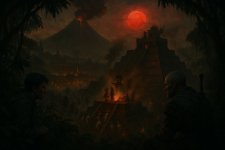
For days, the Waverider’s landing party had pushed upriver, their boat scraping through roots as thick as a man’s waist. The air was heavy and wet, filled with the hum of unseen insects and the slow, patient breathing of the forest itself. Every sound echoed too close, every shadow seemed to move.
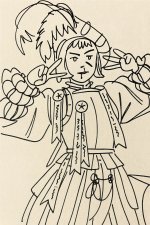
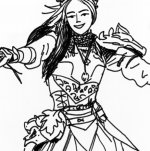
Ileena, their catling guide, led the way from the bow, her tail flicking in irritation as she hissed at the others to keep quiet. Her hair was slick with rain, her eyes narrow slits of green. “The trees listen,” she had warned them once. No one laughed after that.
By the fifth day, the river narrowed to a trickle. The trees pressed in so tight that daylight came only in shreds. Virellus stood at the prow beside her, his face drawn and pale. He hadn’t spoken much since they’d left the sea. None of them had.
Then the river ended.
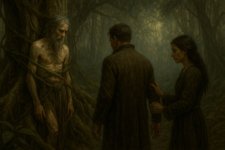
Before them rose a wall of roots, tangled and ancient, the heart of the jungle. And there, at its center, stood a man. Barefoot, gaunt, his skin the color of old parchment. Vines wound around his arms and chest, pulling him gently against the trunk of a massive tree as though the forest itself refused to let him go. His hair hung in damp strings, his beard overgrown and matted with moss.
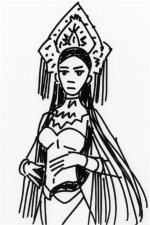
“By the gods,” Selene whispered. “That’s him.”
Captain Virellus took a step forward, his voice barely a breath. “Meronex.”
The man lifted his head slowly. His eyes were wild and bright, unfocused and dull, feverish.
And then, he spoke. His words came out slowly, rasping, and they were either genius or madness. We could not tell which, and I am still not sure.
Do you see them? No... you don’t. Of course, you don’t. You still look for purpose like a child begging the wind to mean something. But they’re all here... the tendrils, the teeth, the unblinking blossoms... yes, yes, they watch. They consume and bloom, bloom and consume, and never once do they ask why.
(He nods forward, gesturing at nothing, at everything.)
You think intelligence is a crown? Pah! A paper crown on a maggot's head! Intelligence is... a flicker, a brief itch on the hide of something older, dumber, and far more divine. Nature does not think, it does not plan. The jaguar does not calculate, the vine does not debate whether to strangle the tree or the corpse it grew through. And yet... it thrives!
(He grins, lips cracked. Blood on his teeth.)
Cruelty? You whisper the word like a curse. But I... I have seen the cruelty of nature, and it is beautiful. Not beautiful like a painting, no. Beautiful like a scream in perfect harmony. The baby bird that dies in the egg because the sun cooked its mother... The fungus that puppets the ant, makes it climb to heaven just to burst with spores. That is not evil. That is not mercy. That is truth with its face unpainted!
(His eyes drift up, as if something immense and invisible looms over him.)
I used to be clever, you know. A student of cycles, of seasons, of symbols. I thought, “Ah, the forest is a system! A mind!” Ha! The forest is not a mind. It is a mouth. And we... we are its meat.
(He leans in, whispering, a conspirator with the abyss.)
You talk of balance. Balance! There is no balance here. Only hunger. Only the ceaseless gnashing of things that will never understand themselves... and need not to! The tree drinks the bones of the dead and grows taller! Is that wisdom? Is that morality? No! it is power! And it is glorious!
(Suddenly angry, he tears a beetle from the air and crushes it, staring at its remains.)
This thing had no thoughts. No doubts. And it will outlive all your libraries. Because it did not care. Because it was. Because being is enough for the forest. It always was. You clutch your precious thoughts to your chest like relics while the soil opens its mouth beneath you, and the roots reach, reach...
(He looks down at his arms, something is crawling on them. He does not brush it off.)
Do you feel them yet? The ones that grow inside us, the ones that whisper in chlorophyll and rot? They told me things. Secrets without language. Truths you must not put in a book.
(He raises his arms, laughing now, voice cracking, mad or holy or both.)
There is no plan. There is no intelligence. There is only the dance of decay, and in that decay... the purest ecstasy! I have seen it. I have heard it in the scream of the frog swallowed alive, in the weeping tree split by lightning... in the silence that comes after. That silence is not peace. It is appetite.
(He suddenly drops limp, sobbing or laughing, it is impossible to tell.)
Oh... how beautiful it all is. How beautiful the cruelty. I was blind. But now, now I see...
(His voice fades, as though the jungle itself is beginning to consume him.)
And the forest... sees me.
For a moment, no one moved. The forest was still, holding its breath around them. Then Meronex’s eyes found his brother. The fever in them flickered, and for the first time, focus returned.
“Leave,” he whispered, voice rough as bark. “The forest is not for you.”
His head dropped forward. The vines that held him tightened slightly, as if to cradle rather than bind.
Solonex stepped forward, trembling, reaching for his knife. “Hold fast,” he said. “We can cut you free.”
Meronex stirred, just enough to raise a hand. “No.” The word was barely sound. A sigh more than a voice.
Selene stepped between them, laying a hand on the captain’s arm. “He is dying,” she said softly. “Let him choose how to end it.”
For a long heartbeat, Solonex stood frozen, rain streaking his face. Then he lowered the knife.
He turned without a word and began walking back toward the boat, his boots sinking into the black water with every step. Behind him, the forest exhaled, a low whisper through the leaves, or perhaps only the wind.
No one looked back.