
Med risk att springa lite OT men hur hanterades Grappling i D&D4? För det var krångligt som attan i trean men något jag minns från Pathfinder är att man där löste det på ett betydligt enklare och bättre sätt.jag minns speciellt en marknadsföringsvideo där de gjorde sig jätteroliga över hur komplicerat Grappling är i 3.5.

You are using an out of date browser. It may not display this or other websites correctly.
You should upgrade or use an alternative browser.
You should upgrade or use an alternative browser.
Grapple i D&D
- Thread starter Organ
- Start date

Oldtimer
Slava Ukraini!
I princip genom att bara ha Grab (målet får Speed 0 och man kan släpa iväg med det) som standard och låta all mer avancerad brottning hamna under olika Class Powers (till exempel hos munken). Det dög fint för mig.Med risk att springa lite OT men hur hanterades Grappling i D&D4? För det var krångligt som attan i trean men något jag minns från Pathfinder är att man där löste det på ett betydligt enklare och bättre sätt.
Strid i D&D behöver ju inte försöka efterlikna en WWF-match.

God45
#PrayersForBahakan
- Joined
- 23 Oct 2012
- Messages
- 24,368
Med risk att springa lite OT men hur hanterades Grappling i D&D4? För det var krångligt som attan i trean men något jag minns från Pathfinder är att man där löste det på ett betydligt enklare och bättre sätt.
Ingen av er kan röra er utom via påtvingad rörelse tills greppet bryts. Ingen annan effekt. Ok för att hålla fast folk i zoner där de blir skadade. Lätt.

Skarpskytten
Ödestyngd världsvandrare
God45
#PrayersForBahakan
- Joined
- 23 Oct 2012
- Messages
- 24,368
Grappling means wrestling and struggling hand-to-hand.
Grapple Checks
Repeatedly in a grapple, a character needs to make opposed grapple checks against an opponent. A grapple check is something like a melee attack roll.A character's attack bonus on a grapple check is: Base attack bonus + Strength modifier + special size modifier
Special Size Modifier
The special size modifier for a grapple check is as follows: Colossal +16, Gargantuan +12, Huge +8, Large +4, Medium-size +0, Small –4, Tiny – 8, Diminutive –12, Fine –16. Use this number in place of the normal sizemodifier a character uses when making an attack roll.Starting a Grapple
A character provokes an attack of opportunity from the target the character is trying to grapple. If the attack of opportunity deals the character damage, the character fails to start the grapple.To start a grapple, a character first needs to grab and hold a the target. Attempting to start a grapple is the equivalent of making a melee attack. If a character gets multiple attacks in a round, a character can attempt to start a grapple multiple times (at successively lower base attack bonuses). A monkcan use his unarmed attack rate of attacks per round while grappling.
Step 1
Grab: The character makes a melee touch attack to grab the target. If the character fails to hit the target, the character fails to start the grapple.Step 2
Hold: Make an opposed grapple check. If the character succeeds, the character has started the grapple, and the character deals damage to the target as if with an unarmed strike.If the character loses, the character fails to start the grapple. The character automatically loses an attempt to hold if the target is two or more sizecategories larger than the character is (but the character can still make an attempt to grab such a target, if that's all the character wants to do).
Step 3
Move In: To maintain the grapple, the character must move into the target's space. Moving, as normal, provokes attacks of opportunity from threatening enemies, but not from the character's target.Step 4
Grappling: The character and the target are now grappling.Grappling Consequences
While a character is grappling, that character's ability to attack others and defend itself is limited.No Threatened Squares
A character doesn't threaten any area while grappling.No Dexterity Bonus
A character loses its Dexterity bonus to AC (if it has one) against opponents it isn't grappling. (A character can still use the bonus against opponents the character is grappling.)
When a character is grappling (regardless of who started the grapple), the character can make an opposed grapple check as an attack. If the character wins, the character can do the following:In addition to making opposed grapple checks, a character has a few other options while grappling.
Attack Your Opponent
A character can attack with a light weapon while grappling (but not while pinned or pinning). A character can't attack with two weapons while grappling.Damage Your Opponent
A character deals damage as with an unarmed strike (1d3 points for Medium-size attackers or 1d2 points for Small attackers, plus Strengthmodifiers). If a character wants to deal normal damage, the character suffers a -4 penalty on the grapple check. Exception: Monks deal more damage on an unarmed strike than other characters, and the damage is normal. However, they can choose to deal their damage as subdual damage when grappling without paying the usual -4 penalty for changing normal damage to subdual damage.Escape from Grapple
A character can escape the grapple. A character can take whatever movement the character gets. If more than one opponent is grappling a character, the character's grapple check result has to beat all their check results to escape. (Opponents don't have to try to hold a character if they don't want to.) A character can make an Escape Artist check (opposed by a character's opponent's grapple check) to get out of a grapple or out of being pinned (so that the character is just being grappled). Doing so counts as a standard action; if a character escapes a grapple, the character can also move in the same round.Pin Your Opponent
A character can hold an opponent immobile for 1 round. (If a character gets multiple attacks, the character can use subsequent attacks to damage the opponent. A character can't use a weapon on a pinned opponent or attempt to damage or pin a second opponent while holding a pin on the first.) While a character is pinned, opponents other than the one pinning the character get a +4 bonus on attack rolls against the character (but the character is not helpless).
A character can break the hold that an opponent has over an ally.
When an opponent has pinned a character, the character is held immobile (but not helpless) for 1 round. The character can make an opposed grapple check as a melee attack. If the character wins, the character escapes the pin, but the character is still grappling. A character can make an Escape Artist check (opposed by a character's opponent's grapple check) to get out of a grapple or out of being pinned (so that the character is just being grappled). Doing so counts as a standard action; if a character escapes a grapple, the character can also move in the same round.Joining a Grapple
If a character's target is already grappling someone else, then the character can use an attack to start a grapple, as above, except that the target doesn't get an attack of opportunity against the character, and the character's grab automatically succeeds. The character still has to make a successful opposed grapple check to deal damage and must still move in to be part of the grapple.Multiple Grapplers
Several characters can be in a single grapple. Up to four characters can grapple a single opponent in a given round. Opponents that are one sizecategory smaller than a character count for half, opponents that are one size category larger than a character count double, and opponents two or more size categories larger count quadruple.Additional enemies can aid their friends with the aid another action.
Skarpskytten
Ödestyngd världsvandrare
Bästa brottningsreglerna någonsin! (Jag är inte ironisk, jag tycker verkligen om dem).Grappling means wrestling and struggling hand-to-hand.
Grapple Checks
Repeatedly in a grapple, a character needs to make opposed grapple checks against an opponent. A grapple check is something like a melee attack roll.
A character's attack bonus on a grapple check is: Base attack bonus + Strength modifier + special size modifier
Special Size Modifier
The special size modifier for a grapple check is as follows: Colossal +16, Gargantuan +12, Huge +8, Large +4, Medium-size +0, Small –4, Tiny – 8, Diminutive –12, Fine –16. Use this number in place of the normal sizemodifier a character uses when making an attack roll.
Starting a Grapple
A character provokes an attack of opportunity from the target the character is trying to grapple. If the attack of opportunity deals the character damage, the character fails to start the grapple.
To start a grapple, a character first needs to grab and hold a the target. Attempting to start a grapple is the equivalent of making a melee attack. If a character gets multiple attacks in a round, a character can attempt to start a grapple multiple times (at successively lower base attack bonuses). A monkcan use his unarmed attack rate of attacks per round while grappling.
Step 1
Grab: The character makes a melee touch attack to grab the target. If the character fails to hit the target, the character fails to start the grapple.
Step 2
Hold: Make an opposed grapple check. If the character succeeds, the character has started the grapple, and the character deals damage to the target as if with an unarmed strike.
If the character loses, the character fails to start the grapple. The character automatically loses an attempt to hold if the target is two or more sizecategories larger than the character is (but the character can still make an attempt to grab such a target, if that's all the character wants to do).
Step 3
Move In: To maintain the grapple, the character must move into the target's space. Moving, as normal, provokes attacks of opportunity from threatening enemies, but not from the character's target.
Step 4
Grappling: The character and the target are now grappling.
Grappling Consequences
While a character is grappling, that character's ability to attack others and defend itself is limited.
No Threatened Squares
A character doesn't threaten any area while grappling.
No Dexterity Bonus
A character loses its Dexterity bonus to AC (if it has one) against opponents it isn't grappling. (A character can still use the bonus against opponents the character is grappling.)
When a character is grappling (regardless of who started the grapple), the character can make an opposed grapple check as an attack. If the character wins, the character can do the following:
In addition to making opposed grapple checks, a character has a few other options while grappling.
Attack Your Opponent
A character can attack with a light weapon while grappling (but not while pinned or pinning). A character can't attack with two weapons while grappling.
Damage Your Opponent
A character deals damage as with an unarmed strike (1d3 points for Medium-size attackers or 1d2 points for Small attackers, plus Strengthmodifiers). If a character wants to deal normal damage, the character suffers a -4 penalty on the grapple check. Exception: Monks deal more damage on an unarmed strike than other characters, and the damage is normal. However, they can choose to deal their damage as subdual damage when grappling without paying the usual -4 penalty for changing normal damage to subdual damage.
Escape from Grapple
A character can escape the grapple. A character can take whatever movement the character gets. If more than one opponent is grappling a character, the character's grapple check result has to beat all their check results to escape. (Opponents don't have to try to hold a character if they don't want to.) A character can make an Escape Artist check (opposed by a character's opponent's grapple check) to get out of a grapple or out of being pinned (so that the character is just being grappled). Doing so counts as a standard action; if a character escapes a grapple, the character can also move in the same round.
Pin Your Opponent
A character can hold an opponent immobile for 1 round. (If a character gets multiple attacks, the character can use subsequent attacks to damage the opponent. A character can't use a weapon on a pinned opponent or attempt to damage or pin a second opponent while holding a pin on the first.) While a character is pinned, opponents other than the one pinning the character get a +4 bonus on attack rolls against the character (but the character is not helpless).
A character can break the hold that an opponent has over an ally.
When an opponent has pinned a character, the character is held immobile (but not helpless) for 1 round. The character can make an opposed grapple check as a melee attack. If the character wins, the character escapes the pin, but the character is still grappling. A character can make an Escape Artist check (opposed by a character's opponent's grapple check) to get out of a grapple or out of being pinned (so that the character is just being grappled). Doing so counts as a standard action; if a character escapes a grapple, the character can also move in the same round.
Joining a Grapple
If a character's target is already grappling someone else, then the character can use an attack to start a grapple, as above, except that the target doesn't get an attack of opportunity against the character, and the character's grab automatically succeeds. The character still has to make a successful opposed grapple check to deal damage and must still move in to be part of the grapple.
Multiple Grapplers
Several characters can be in a single grapple. Up to four characters can grapple a single opponent in a given round. Opponents that are one sizecategory smaller than a character count for half, opponents that are one size category larger than a character count double, and opponents two or more size categories larger count quadruple.
Additional enemies can aid their friends with the aid another action.
Oldtimer
Slava Ukraini!
För egen del tyckte jag, så vitt jag kan minnas, att fokuset på strid kändes tråkigt
Jag får inte riktigt ihop det här. Fokuset på strid i 4E kändes tråkigt, men ett helt separat subsystem för brottningsmatcher i 3E är bra?Bästa brottningsreglerna någonsin! (Jag är inte ironisk, jag tycker verkligen om dem).
Skarpskytten
Ödestyngd världsvandrare
Alltså, det är väl ändå skillnad på den tänka mängden strider i ett spel och kvaliteten på stridssystemet? Man kan väl vilja ha få strider men ett bra system för brottning om den situationen uppstår?Jag får inte riktigt ihop det här. Fokuset på strid i 4E kändes tråkigt, men ett helt separat subsystem för brottningsmatcher i 3E är bra?
God45
#PrayersForBahakan
- Joined
- 23 Oct 2012
- Messages
- 24,368
Bästa brottningsreglerna någonsin! (Jag är inte ironisk, jag tycker verkligen om dem).
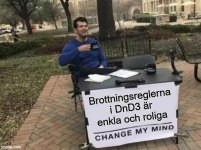
Jag försöker bara motbevisa ”enkla” delen av skylten
 Jag har spelat en hel kampanj där en spelare var en grapplande Were-Bear och det var kul!
Skarpskytten
Ödestyngd världsvandrare
De kanske inte är enkla, nej. Men de går att lära sig! Jag kunde dem. Och sett till hela DnD3 regel-korpus så är det verkligen inte mycket att plugga in. Det är lite som att folk var beredda att lägga 100 timmar på att lära sig DnD3 sen började gnälla för att de inte orkade lägga en extra timme på att plugga in brottningsreglerna.Jag försöker bara motbevisa ”enkla” delen av skylten
Last edited:

MODERERINGMed risk att springa lite OT ...
Jag har nu brutit ut Grapple-diskussionen, som hotade att ta över tråden.
Om ni tänker "det här är nog OT"redan innan ni postar så är det bästa valet att skapa en ny tråd.
MVH
/Magnus
Oldtimer
Slava Ukraini!
Då vet jag inte riktigt varför 4E hade "fokus på strider". Stridsreglerna där var ju betydligt enklare och mer kortfattade än i 3E. På vilket sätt var "den tänkta mängden strider" större i 4E än i 3E? Jag tänker tvärtom att mängden regler för något visst moment avspeglar spelets fokus på det momentet.Alltså, det är väl ändå skillnad på den tänka mängden strider i ett spel och kvaliteten på stridssystemet? Man kan väl vilja ha få strider men ett bra system för brottning om den situationen uppstår?
Skarpskytten
Ödestyngd världsvandrare
Jag tänker tvärtom att mängden regler för något visst moment avspeglar spelets fokus på det momentet.
Nu är vi inne på ett sidospår till sidospåret här ...
Det är en åsikt som framförs ibland och som jag inte alls håller med om. Jag tror vi har haft ett epsikt gräl om detta häromåret men jag är för lat för att leta upp tråden.
Min bild av DnD4s äventyr (de som WotC gjorde alltså) mest bestod av stat-block och kartor över strider och var typ "ni ska utkämpa de här striderna i rätt ordning annars tar Rollspelsverket er". Men jag får erkänna att det bygger på ytliga observationer.
Last edited: