WRNUs kreativitetskalender 2025

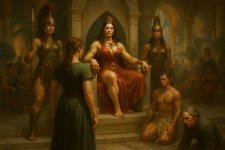
Nu är Waverider i Mataraaj, ett land sönderslitet av ett inbördeskrig med ständigt skiftande allianser. De har fått en audiens hos Maharaja Samyra Devi.
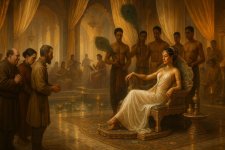
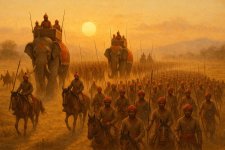
20251020_1535_Majestic Mataraaj Chamber_simple_compose_01k80x6djtftxr1qc9mnz2fzdx.jpg20250929_1957_Indian Army March_simple_compose_01k6b9r644fj2a31rjmhjyefy3.jpg

Vardhana shimmered like a mirage built from jewels and heat.

Even the air seemed perfumed - with rose oil, cardamom, and faint smoke from temple fires.

The crew of the Waverider walked through streets bright with silks and brass, where dancers moved between spice stalls, and beggars bowed beside golden palanquins. The sound of a thousand wind chimes filled the city like the breath of some great sleeping god.

At the palace, sunlight poured over marble domes and peacock mosaics. Courtyards bloomed with fountains whose waters glowed pale blue from powdered sapphires. Guards in mirrored armor stood motionless as the visitors were led through corridors of incense and shadow.

They were taken into the harem court, the private heart of Maharaja Samyra Devi's world.

The air was thick and slow there, perfumed and heavy with music. Curtains of gold-threaded silk drifted lazily in the breeze of hidden fans. Musicians played veena and flute in soft counterpoint. Pools of scented water caught the light from hanging lamps, and the floor was scattered with jasmine petals.

Samyra reclined upon the Peacock Throne, not the one seen by ambassadors in the great court, but its twin, smaller and infinitely more dangerous. Her robe was woven from white silk so sheer it seemed spun from mist; her skin gleamed with oil and gold dust. Around her stood her attendants, tall, lithe men, their bodies bronzed and bare save for jeweled belts and bright sashes. Some poured wine, some fanned her with peacock plumes, others simply waited, motionless, like statues carved to honor desire itself.

Yet her eyes, rimmed with kohl, were clear and sharp.

They missed nothing.

Captain Solonex bowed, measured and formal. "Your Majesty. We bring a message from Raja Chandravir of Kandral."

"Then speak it," she said. Her voice was low, musical, carrying the weight of command softened by silk.

Severin stepped forward, unfolding the parchment. "The Raja of Kandral swears his banners to you, Majesty. His treasury, his army, his loyalty, in exchange for your alliance against his enemy, Raja Rajnath of Varnapura."

The chamber quieted. Even the musicians stilled.

Samyra's gaze sharpened; the corner of her mouth curved like the edge of a blade.

"Rajnath starves his men to build marble shrines," she murmured. "Kandral breeds warriors. So be it."

She turned slightly. "Raya," she said, and a figure stepped from behind a screen: her spymaster, cloaked in indigo, a jeweled dagger at his belt. "Send word to Kandral. Accept the pledge. Quietly. And send General Devendra with the next caravan. He will seal the pact with strategy and steel."

Raya bowed low and vanished like a shadow into incense smoke.

Samyra rose from the throne. Her movements were slow, deliberate, like the shifting of a serpent.

"You have served me well," she said. "Few men travel across the jungles to bring a queen her victory."

She gestured to an attendant, who opened a chest of sandalwood, coins, pearls, bolts of silk spilling into the light. "Take this. And take my thanks. You have brought me a turning in the war."

Her gaze lingered a moment on Solonex. "But know this: every victory in Mataraaj is paid for twice, once in blood, once in loyalty. Choose which you value more."

He bowed his head slightly. "Wisdom noted, Majesty."

Venera's eyes moved over the scene, the jeweled attendants, the soft music, the scent of oil and wine. This was not decadence, she thought, but control in its most exquisite form. In Omros, the powerful demanded submission through fear. Here, it was through beauty.

When the crew was dismissed, they passed beneath the silken curtains and out into the corridor of cool stone. Behind them came the sound of laughter, Samyra's, low and rich, like a drumbeat wrapped in velvet.

Outside, the sun was merciless. The city of Vardhana blazed with banners of gold and peacock blue. The air shimmered above domes and towers, as though the world itself were holding its breath.

"She rules like a storm wrapped in silk," Severin said quietly.

Venera nodded. "And she's the eye of it, calm, until she decides not to be."

Solonex adjusted the pouch of coins at his belt, glancing back at the gleaming palace. "Strength wears many faces," he said. "That one smiles while she cuts."

They walked down the marble steps toward the harbor. Behind them, the palace shimmered in the heat, a dream of gold, silk, and shadow. And somewhere within it, a queen smiled, already planning the next move in her long and patient war.
 
18: Värld #4-93759271381081923
En värld av vidsträckta hav, krönt av myriader av små karga öar. Eftersom öarna främst består av sten är träd sällsynta, trots att de är nödvändiga för att bygga sjövärdiga skepp. Den som äger ett fartyg betraktas därför som en mäktig regent, och skeppen får ofta en närmast religiös innebörd.

I djupen lever stora sjöodjur av en för mig okänd art. På nätterna kan man höra deras parningsrop i fjärran. Ett dovt, mullrande ljud.
 
You want it darker? Nu är Waverider där det är riktigt mörkt (och då skrapar de ändå bara ytan...), Drowned Marshes.

20251020_1104_Mystery at Sea_simple_compose_01k80dqapgehe881vskrebxy6v.jpg20251020_1227_Shadowy Creatures Lurking_simple_compose_01k80jeg4hf4j9erkq1h7jwmc9.jpg20251020_1253_Navigators at Sunset_simple_compose_01k80kygv2fb88qpx43fv8we58.jpg

The coast of the Drowned Marshes looked dead even from a mile out.

A gray line of mangroves rose from the sea like rot, their roots black and tangled, the water between them dull as lead. The only sign of habitation was a cluster of huts on stilts, smoke drifting low across the tide. No birds circled. No laughter carried. Even the waves seemed to hush as the Waverider drew near.

They made anchor where the planks looked least ready to collapse.

A few villagers waited there, silent, watching. Their clothes were simple, clean enough, but their eyes flicked constantly toward the inland fog. Always the same glance, as if counting something unseen.

Virellus stepped ashore first, Severin and Rahim behind him, Eira keeping watch near the boat. "Let's make this quick," the Captain murmured. "I don't want the tide going out under us."

Trade began easily enough. Dried fish for salt, mangrove wood for nails, a basket of swamp pearls that glimmered faintly pink in the light. The villagers spoke little, their words soft and rehearsed, like lines recited under threat. The children stood in doorways but never came closer. Even the dogs were silent.

One man, older, narrow-shouldered, did the bargaining. He smiled when Severin approached, but the smile was brittle. His hands shook as he counted out the coin. When he passed the last piece across, his fingers brushed Severin's palm, a fleeting contact, almost accidental.

Something small and folded rested there.

Severin didn't look down. He pocketed it with a single smooth movement, thanked the man, and turned away.

The villager bowed quickly and stepped back, eyes darting toward the mist.

They finished loading the trade goods without incident.

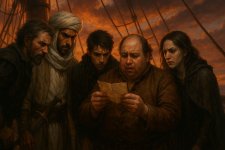
Only when the Waverider was half a league out to sea did Severin unfold the scrap of paper.

The handwriting was uneven, written with something that looked like soot and seawater.

They take our children. They took my wife. My daughters. My son. We are watched always. I am already dead, but the world must know. - T.

The crew gathered around the scrap, the damp wind flattening it against the deck. For a long moment, no one spoke.

Then Virellus said, quietly, "They're doing it again."

Rahim's jaw tightened. "The Synod."

Selene crossed herself in silence.

The Captain's expression hardened. "If they're taking children, they're not just tyrants anymore. They're butchers."

Severin folded the note carefully. "And clever butchers. A letter like this should never have reached us."

"Someone has to see what's true," Virellus said. "If they're hiding something, I want eyes on it."

His gaze shifted to Gato, who was sitting on a coil of rope, sharpening his knife with idle precision. "Gato," the Captain said. "You know swamps."

Gato looked up, grinning faintly. "Better than they know me, Cap'n."

"Good. Go find out what's happening inland. Take the small boat. Two days, no longer."

The grin faded. "Aye."

He stood, tested his blade, and looked toward the green horizon where the mist thickened into the swamp. "Looks quiet," he said.

Severin closed the folded note in his hand. "That's what frightens me."

The Waverider drifted at anchor as Gato climbed into the skiff, the oars dipping soundlessly into the gray water. He rowed toward the mangroves until the mist swallowed him whole.

For a while, they could still hear the slow rhythm of the oars.

Then even that was gone.

----

The swamp had no horizon.

Just gray sky melting into gray water, broken by reeds and the shapes of trees that might once have been alive. Gato moved through it like a ghost, his skiff gliding between the roots. Even the insects seemed afraid to make noise here.

He followed the sound before he saw it. A slow splash of oars somewhere ahead, the rasp of a voice echoing over still water.

He pulled his skiff against a tangle of mangrove roots and waited.

Through the mist, a procession took shape: a long black boat, rowed by slaves whose eyes were covered with strips of cloth. At its center sat a man in a crimson cloak, bronze mask gleaming dully in the half light. Four guards stood around him, bare-chested, their skin painted in streaks of red. Their weapons dripped water.

They approached a stilt-village half lost in fog.

At once, the villagers appeared, spilling from their huts like frightened birds, bowing low. None dared speak. Some of them bore signs of work, arms too long, mouths sealed with scar tissue, eyes sunken and wet, as though they'd been reshaped to suit some unseen purpose, or as punishment.

The man in crimson stepped onto the pier. He did not walk so much as glide, the hem of his cloak never wetting. He surveyed them in silence, the bronze mask unreadable.

Then he lifted one finger.

Two children were pulled forward, a boy and a girl, no more than fourteen. The boy's jaw trembled; the girl's hands were balled so tightly her knuckles shone white. A woman tried to reach for them, but another villager caught her arm, whispering frantically into her ear.

The guards seized the children and dragged them into the boat.

A few people cried, softly, behind their hands. No one else moved.

The man in crimson turned without a word, sat, and the boat slid back into the mist.

Gato waited until the ripples died, then followed.

Hours passed. The sky never changed, only deepened from gray to black, the air heavy as breath.

When the boat stopped, it was before a black stone tower rising from the water like a finger pointing at nothing. No light showed within. The children were taken through a door at its base.

Gato's pulse hammered, but he waited. When the last torch went out, he rowed closer.

The stone was slick, but the vines made handholds. He climbed in silence until he reached a narrow window cut into the wall. Faint light pulsed from within, red and sickly, like a heartbeat behind cloth.

He looked.

For a long moment, his mind refused to understand what it saw.

A dead woman lay sprawled on the floor, her belly torn open.

A small creature crouched below her ribs, something shaped like a child but wrong in every proportion, its skin a black sheen of scales, its mouth too wide. It was eating. Delicately. Chewing.

Her face was turned toward him, eyes glassy with pain, breath catching in tiny, broken sobs, and he realized she was alive, and gasped.

The demon thing paused.

Its head turned toward the window. Its eyes, gold and wet, locked on Gato's.

He froze.

The creature smiled. And in that instant, something moved in the darkness behind it, something far larger, hunched and breathing in rhythm with the woman's fading gasps.

A second pair of eyes opened. Red, dull, ancient.

Gato's hand slipped on the stone. The sound was tiny, but enough.

The thing in the shadows stirred, massive and slow, the air around it shifting as if the swamp itself were inhaling.

Gato's heart stuttered. He didn't think; he dropped.

He hit the water hard, the cold shocking him into motion. He swam, splashed, ran when he hit the shallows, dragging himself through reeds and mud until he found his skiff. Behind him, nothing followed, but the swamp seemed to close over the noise, swallowing even his breath.

He rowed without rhythm, without thought, the oars cutting black water that didn't want to be moved.

Only when the Waverider's lights flickered through the fog did he dare look back.

Nothing there. Only mist. Only the endless quiet.

He rowed faster, and the fog swallowed the sound.

----

The sea mist clung to the Waverider like cobwebs when Gato returned.

They hauled him aboard in silence. His hands were shaking, his face streaked with mud and something darker. He didn't speak at first. He just sat on the deck, breathing in harsh, shallow bursts. When Virellus knelt beside him, he started to talk, disjointed, half-choked words spilling out like seawater from a cracked hull.

He told them what he had seen.

The man in crimson.

The children.

The tower.

Then the woman, the body, the thing that was not a child. The eyes that found him.

By the time he finished, his voice was gone. He sat there, shoulders hunched, trembling, staring at the boards beneath him as if afraid something might look back through the cracks.

"I ran," he said finally. "Gods forgive me, I ran. Those children..."

He broke off, covering his face. "They'll die screaming. And I ran."

Captain Solonex knelt beside him, placing a steady hand on his shoulder. "You did what you had to," he said quietly. "If you'd stayed, you'd be one more body feeding their monsters. Instead, you came back. You brought us truth."

He looked at the others. "A dead hero helps no one. A living scout saves lives."

No one spoke for a while. The sound of the waves filled the silence, slow, heavy, like a heartbeat through the hull.

Then Solonex rose. "So now we know what they are." His voice was iron. "Tell me, Decimus, can we fight them?"

Decimus leaned on the rail, eyes distant. "Not here. Not now. They know their ground. We don't." He shook his head. "We couldn't win."

Venera crossed her arms. "We're explorers, Captain. Our task is to map the world, not to burn it. You can't fight every horror we find."

Solonex turned to her, jaw tight. "So we look away?"

"Sometimes," she said softly, "that's all you can do."

He started to speak again, but Decimus cut in, his tone level, factual. "Even if we struck one of them, one of their towers, the others would know. There are many. Kill one, and the rest come for you. You'd be fighting the swamp itself."

Selene's voice was low. "And the people there aren't soldiers. They've lived in terror for generations. They'd fight for their masters because they're too afraid not to."

Solonex looked from one face to another, anger, sorrow, exhaustion reflected back at him. "So we do nothing?" he demanded.

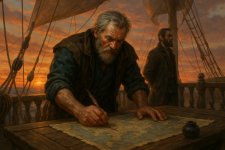
Severin had been silent until then, standing apart near the chart table. His voice was calm, but it carried. "We finish what we came for. We mark what we've found. That's what we do."

Solonex turned sharply. "You think we should just run?"

"No," Severin said. "I think we should remember."

He stepped closer.

"Power draws power, Captain. Sooner or later, someone stronger than us will come looking, an empire, a crusade, a warlord hungry for glory. When they do, they'll need to know where to strike. The best thing we can do is put the Crimson Synod on the map. Make them real. Make them known. An army can give the people the courage to rise up."

He paused, his voice dropping lower.

"If those people are ever freed, it won't be out of mercy. It'll be because someone else wants what the Synod has. And, probably, that someone will be less cruel."

The deck was silent again, the air heavy with salt and smoke and the faint stench of swamp clinging to Gato's clothes.

At last, Solonex exhaled, slow and bitter. "Fine."

He looked to Pheadros at the chart table. "Mark it. Clear and black: The Drowned Marshes. The Crimson Synod."

He turned toward the crew. "Then set the sails. We're done here."

The Waverider's anchors lifted with a groan. The ship turned seaward, cutting through the gray waves as the mist thickened behind them. For a long time, no one spoke.

Gato stood at the stern, staring into the fog where the swamp had vanished. His eyes were hollow, his voice a whisper.

"The children," he said. "they'll still die... giving birth to demons."

Solonex didn't answer. The wind filled the sails. The swamp was gone.

But on the map, for the first time, it had a name.
 
Lucka 19:
Värld 2-7459290220

En fruktansvärd kyla har drabbat denna värld, en vinter som aldrig vill ta slut. Det sägs att det för blott ett decennium sedan var en grönskande plats, men det är svårt att föreställa sig idag när ett tjockt lager is och snö täcker marken.

Enligt sägnen kom den eviga vintern efter att människorna dräpte den gudomliga mammuten Erokkah. Dess enorma skelett kan ses på mils avstånd där det ligger ute på tundran, likt ett taggigt vitt berg. Sedan dess har guden Ha tystnat, och allt som återstår är en desperat kamp för överlevnad i kylan och mörkret.
 
Jag hade tänkt bli klar med en gatlopps-dungeon som lucka 24, men har bara hunnit skriva ett par rum. Tänker att jag ändå langar konceptet här och så kanske jag gör klart den efter allt julbestyr:

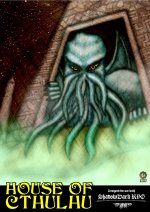
House of Cthulhu är en funnel till Shadowdark baserad på Brian Lumleys Sword and Sorcery-novell "The House of Cthulhu". Rollpersonerna är galärslavar på piratdrottningen Zurthalas skepp The Dragon. Zurthala har i sin hybris drömt om att erövra den beryktade staden R'lyeh och när den en dag dyker upp på havet för hon skutan dit. Äventyret börjar med att besättningen landstiger den omöjliga staden, som prompt öppnar upp sig och slukar dem alla. Merdelen av besättningen dör, men ett gäng slavar överlever alltså och måste nu navigera R'lyehs innanmäte för att hitta en väg ut. Faktioner består av Deep Ones-väktare och en mänsklig Cthulhu-kult som förtidigt vill väcka den store Cthulhu. Fällor, drömspöken, tentakler och en Aboleth som vaktar utgången.

Ska försöka göra klart den till ett konvent jag anordnar nästa år, här är omslaget tills vidare:
1000022630.jpg
Blev inte jättemånga luckor från mig i år, men så kan det vara - god jul!
 
Last edited:
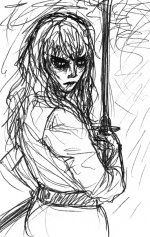
Nu är Waveriderbesättningen i fjärran Ozukari. Ett land där ingen är slav, men hierarkierna är så starka att i praktiken är alla slavar. Att störa den ordningen är att öppna dörren för demoner.

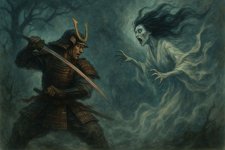
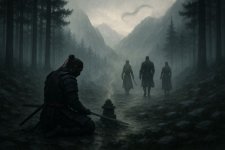
20250624_1957_Samurai vs Ghost_simple_compose_01jyhhafmseeta215p26xmqtxn.jpg20251021_1142_Samurai's Silent Vigil_simple_compose_01k83291cqfq9b891h10wfv0hj.jpg

The road wound through mist and pine.

Gray light filtered through the branches, glinting on wet stones and the distant glimmer of rice terraces. The air smelled of rain and smoke, the cold kind that lingers after something has burned.

At the crossroads stood a single figure.

A warrior knelt beside a small shrine of stacked stones, his armor lacquered black, a crimson cord binding his topknot. His sword rested before him, edge turned upward. He was perfectly still, as if carved there by devotion alone.

The three travelers, Decimus, Rahim, and Venera, halted a few paces away. None of them spoke at first. The silence felt sacred, or at least dangerous.

Finally, Decimus said softly, “We mean no insult, warrior. Is this your land?”

The man opened his eyes. They were dark and calm. “No man owns land,” he said. “Only order owns land. I am here because order was broken.”

Rahim frowned. “Broken how?”

The warrior looked back toward the valley. “The lord of this province took his own life. He had a concubine of rare beauty. His lord demanded her, and he refused. He slew her rather than surrender her, then cut his own belly and died beside her. In that moment, loyalty was severed. One master dead, one oath unkept. Such acts call to the dark.”

Venera’s brow creased. “You mean demons?”

He inclined his head. “Disorder breeds hunger. And hunger takes form.”

The wind stirred, carrying the faint toll of a distant temple bell.

Rahim shifted uneasily. “Then you wait for it?”

“I do not wait,” the warrior said. “I listen.”

The three said nothing. Then the wind changed.

It came low and hot, smelling of blood and ash. The shrine stones trembled. From the mist above the road, a shape slid into being, half shadow, half flesh.

It moved on twisted limbs, its skin red and slick like raw meat. A face stretched across its chest, eyes wide, mouth howling without sound. The warrior rose, sword flashing free in one smooth motion.

“Order against chaos,” he said. “Stand with me, or stand aside.”

Decimus drew steel. Rahim did the same. Venera stepped back and drew a dagger.

The demon lunged. The first strike came fast, claws like hooked glass, but the warrior met it head-on, blade cutting sparks from its hide. Rahim struck from the side, the blow glancing off bone. Decimus feinted low, driving his blade into the creature’s leg. It shrieked, the sound thick as smoke.

The warrior’s sword came down like falling silence. One stroke, clean and final.

The demon’s body burst into black ash. The smell of burnt iron filled the air. Ash drifted like snow, vanishing before it touched the ground. For a long time, no one moved.

Then the wind turned cold again. The mist folded in, erasing all trace of the fight.

The warrior cleaned his blade and knelt once more beside the shrine.

“It is done,” he said. “The world breathes again.”

Decimus sheathed his sword. “You make it sound like this happens often.”

“It does,” said the warrior. “Where men break faith, demons always follow. But when order is restored, they fade.”

Rahim glanced at the shrine. “And what about you?”

“I remain until the road is quiet,” the warrior said simply. He closed his eyes, returning to stillness.

The three travelers looked at one another, then turned toward the western path. The mist thinned behind them, and soon the sound of the forest swallowed all else.

After a time, Venera said, “He fought without hesitation. No hate, no fear.”

“Faith,” Rahim murmured. “That’s what order gives them.”

Decimus’s voice was thoughtful. “Or what slavery demands of them. Perhaps in Ozukari, the two are the same.”

They walked on. Behind them, at the crossroads, the meditating figure remained unmoving, a shadow among the pines, guarding silence against the dark.

And far above, where the mist met the mountain, a single ripple of darkness curled through the air, faint, shapeless, waiting.
 
På utsidan finns ingången till en gruva, omgiven av futuristiska fyrkantiga prefab-byggnader.

Tycker det är en rätt ball idé med distansutredning! I Richard Morgans Black Man genomförs ett förhör över länk mellan jorden och Mars, med flera timmars fördröjning mellan svaren. Det skulle man kunna använda som någon form av pacing här.
 
Waveriders kapten Solonex, också känd som Captain Not-For-Sale hälsar från Amazireth, amazonernas rike.

20251012_1929_The Temptation of Power_simple_compose_01k7cqckg8fz0a7kh1sd4nhmbr.jpg

The palace of Amazireth rose like a mirage above the jungle, its domes and spires glittering in the heavy sunlight. Gold caught every breeze, and the scent of incense drifted through the air so thick it clung to the lungs. The Waverider’s crew had seen wealth before, but never this kind; it didn’t gleam, it smothered.

Inside, the throne hall was a garden of stone and flesh. Slaves fanned the air with plumes, musicians plucked strings of silver, and perfumed courtiers lounged like ornaments. Upon the dais sat the Queen of Amazireth, radiant and terrible, her skin oiled, her jewels bright as blood. She regarded Captain Virellus the way a collector might examine a fine animal.

“So,” she purred, “this is your male?” Her gaze slid toward Venera. “A fine specimen. I will buy him.”

The hall fell silent.

Venera straightened. “He is not for sale, your Majesty.”

The queen tilted her head, her smile sharpening. “Not for sale? Then you prefer trade?” She gestured lazily, and a male slave was brought forward, tall, muscular, only wearing a minimal loincloth, his body marked in gold paint. “This one has been good between my legs. I will trade him for your man.”

A murmur rippled through the court. Virellus said nothing, though the muscle in his jaw twitched.

Severin Valerius stepped forward, his voice smooth and practiced. “Your Majesty, I fear there is a misunderstanding. The captain...”

He didn’t finish. One of the queen’s guards struck him across the face with the butt of a spear, sending him sprawling across the marble.

“You will not speak for a woman,” the queen said, her tone gentle like a cobra waiting to strike.

The silence that followed was heavy enough to crush the air. Venera’s hand hovered near her blade. Eira took a step forward, then stopped when Virellus raised one hand, not in command, but in warning.

Venera smiled. Calm. Controlled. “Your Majesty honors me beyond measure,” she said. “But if you would accept a gift instead, a token of goodwill from one sovereign to another, we would be deeply grateful.”

The queen leaned back, amused. “A gift?”

“Rare spices,” she continued, “and a chest of Olydrian glass. Even the Empire hasn’t seen either in a generation.”

There was a pause, then laughter. The queen clapped her hands once, sharply. “Fine. I will take your gift, Captain Not-For-Sale. Your woman may keep you.”

The audience ended in polite ceremony. Severin limped out under Selene’s arm, muttering oaths through a split lip. The guards returned their weapons to their shoulders. The queen’s laughter followed them down the marble steps.

By nightfall, the Waverider had left Amazireth behind, her sails dark against the moonlight. On deck, the crew said little. The jungle coast was already a shadow.

Venera stood beside the captain at the helm. “So,” she said at last, her voice dry, “if I’d sold you, would I have become captain?”

Virellus didn’t look at her. “Only for a day.”

“Why only a day?”

“Because Ulfar would have killed you by morning.”

Venera grinned faintly, the tension breaking at last. “Fair enough.”

The Waverider sailed on through the dark, leaving the golden towers of Amazireth to gleam unseen beyond the horizon.
 
Nu kommer en mörk hälsning från Waverider på årets mörkaste dag, från mörkaste platsen: Srel Colony. Men, de lyser upp den.

ChatGPT Image Sep 16, 2025, 04_35_43 PM.jpg20251013_1424_Dawn on Waverider_simple_compose_01k7erbkmweh1beyx7mz5y631f.jpg

The Waverider lay anchored off the coast of the Srel colony, her sails slack in the heavy air. The jungle rose behind the shore like a green wall, steaming in the noon sun. The crew rowed in under the crack of insects and distant drums, the oars cutting through red-tinted water thick with mud.

They had expected trade, maybe even diplomacy. What they found instead was silence.

The village was gone.

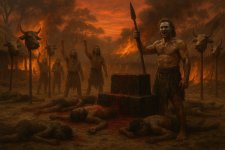
Huts lay blackened, half-sunk in ash. The air stank of smoke and blood. Chickens lay split open in the dust beside the bodies of men, women, and children. Flies hung thick in the air.

And then came the laughter.

Down by the riverbank, the Sreli were celebrating. Pale-skinned, sharp-faced, their blue and white banners flapping as they danced among the corpses. They had painted themselves with the blood of the slain, streaks across their cheeks like blessings. One man was sawing off a hand with a dull knife. Another tossed a child's doll into the fire and laughed when it burned.

Venera's hand went to her sword. "By the gods..." she whispered.

Captain Virellus stepped forward. "Stop this!" His voice carried across the clearing, sharp as a blade. "These were people, not enemies."

The Sreli commander turned. His face was young, sunburned, eyes alight with something that wasn't madness ... conviction. "They were trespassers," he said proudly. "This land is ours now. The gods gave it to us. All that crawls upon it is ours to take or to kill. We are the chosen, and the chosen do not ask permission."

Kethra spat in the dirt. "Chosen by what? Greed?"

The man smiled thinly. "By destiny."

Before Virellus could answer, a sound cut through the clearing, a sob. Small, choked. From beneath a collapsed hut stumbled a boy, no older than five, his skin streaked with soot and tears. The Sreli turned as one, grinning.

"Another one!" one shouted. "Catch him!"

The boy ran. The Sreli charged after him, their laughter shrill.

"Stop!" Virellus shouted, but they didn't.

Gato moved first. He was gone before the others drew breath, a blur between the huts. The first Sreli dropped with a knife in his throat, the second with an arrow in the spine. Then the rest of the crew moved - Venera and Eira side by side, Ulfar roaring like thunder, Kethra's blades flashing silver. The clearing erupted in chaos.

The Sreli were disciplined, but they hadn't expected resistance. Their zeal met steel. Within minutes, the fight turned. A few of the Sreli fell, the rest broke, shouting curses as they fled toward the jungle.

"We'll return!" one of them screamed. "You'll burn with the rest when our kingdom comes!"

Then they were gone, their words carried off by the wind.

Selene ran to the boy, checking for wounds. From the edge of the forest, others emerged, villagers, smoke-streaked, bleeding, but alive. They gathered around her, clutching one another, speaking in hurried tones. One of the elders stepped forward, his hands trembling.

"You saved us," he said. "We will take the boy and flee inland, to a village deep in the jungle. They will shelter us."

Virellus nodded. "Go quickly. Don't come back."

The survivors bowed low before disappearing into the green.

For a long time, no one spoke. The smell of blood and ash hung heavy in the heat.

Virellus looked back toward the coast, where the Srel town could be seen in the distance. "Get back to the ship," he said. His voice was quiet, cold. "We're done here."

As the crew climbed aboard, the captain turned to Gato. "Sneak into the harbor," he said. "Burn it. Burn their stores, their ships, their gods. Burn everything that means anything to these murdering bastards."

Gato nodded once. "Looking forward to it, captain."

He vanished into the night, silent as smoke.

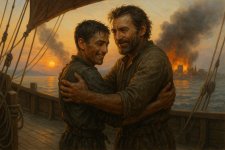
By the time dawn touched the sea, the Waverider was ready to sail. From the distance came a dull orange glow and the faint roar of flames. Gato climbed over the rail, soaked, grinning faintly, the scent of smoke thick on his skin.

Solonex stepped forward, hand outstretched to shake his. Then he stopped, pulled him into a rough embrace instead. "Good work," he said.

Gato nodded against his shoulder. "They won't build again soon."

The ship turned. Behind her, the Srel town burned, its flames licking the morning sky. The smell of smoke carried far, mingling with salt and silence, and the pillar of smoke could be seen for a long time. The Waverider turned her prow seaward.
 
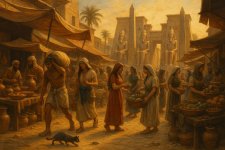
Nästa hälsning från Waverider är från ökennationen Lumekhet, där att handlar om cykeln mellan liv och död, och tillbaka till liv. En del föds utan själ där, och att möta dem är farligt.

20250612_1456_Ancient Egyptian Street Scene_simple_compose_01jxj390d1ey9bwm8xvb5qy07x.jpg20250828_1536_Birth, Life, Journey_simple_compose_01k3re623kej9ts3224f9qsg0w.jpg20251014_1250_Footprints in the Sand_simple_compose_01k7h5dnc1er4a29hsmstnsp6f.jpg

The Waverider lay moored at dusk between the twin waters, the Zareth and the Kenu - the two veins of Lumekhet.

Beyond them, the desert burned down to silence; between them, life still clung - slow, ordered, reverent.

Captain Virellus and a few of the crew had gone ashore to barter for grain and water jars. The village stood low among the reeds, its mud-brick walls gold in the last light. Smoke rose from clay ovens. The air smelled of millet, sweat, and incense.

Everything moved with ritual grace - the living imitating eternity.

Children carried baskets on their heads, adults recited the sun's farewell, and even the river seemed to breathe in rhythm.

As night fell, the moon rose - thin, white, watchful.

It was then that a man came walking from the west.

He wore traveler's robes, pale with dust, and his eyes were calm, almost kind. He smiled easily, though no one remembered when he had joined them. The Lumekheti took him for a pilgrim and welcomed him to their fire.

He spoke softly, and his voice drew people nearer. He asked questions that felt like remembering - about names, about birthplaces, about dreams. Each time someone answered, he smiled faintly, as if confirming something he already knew.

Selene sat close, her hands folded. "You travel far, stranger?" she asked.

He tilted his head. "Far enough to see where the rivers end."

"The rivers have no end," said Eira. "They turn and return."

His smile deepened, but his eyes did not change. "Everything returns," he said. "But not everyone remembers how."

Virellus watched him in the firelight - too still, too precise. The man ate nothing, drank nothing. Yet somehow his presence filled the space, as if he were the center and they, the shadows that circled him.

Later, when the fire had burned low, the Lumekheti guide stood and said he would fetch more wood. He did not return.

By dawn, the village was stirring again. Birds called over the river, and the sand glowed pale as bone. The stranger was gone.

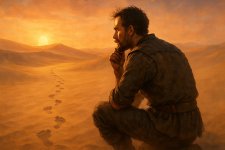
At the edge of the camp, where the guide had walked, the sand was marked by a single line of footprints. They led west, toward the desert. There was no return trail.

No one spoke for a long time. The Lumekheti simply bowed their heads and murmured a prayer for the nameless.

Selene whispered, "He took him."

Virellus shook his head. "No. He followed."

Severin's voice was low, analytical, but uneasy. "If the soul has a path - east for birth, west for death - then what walks beside it when the path is broken?"

Eira looked toward the brightening horizon. "Maybe that's what we saw. The space between."

The crew returned to the Waverider in silence. The river shimmered beneath the sun, smooth as glass. Behind them, the village resumed its prayers, its market calls, its rhythm of living and dying as if nothing had passed through it.

Only Virellus looked back. For an instant, he thought he saw a figure standing on the bank, motionless, watching. Then the light shifted, and there was nothing but heat and water and the hush of the eternal cycle.

By midday, the wind rose. Sand drifted down from the dunes, soft as ash.

The footprints were already gone, the sand undisturbed as far as they eye could see.
 
Lucka 23. Kryptropolis, man spelar väsen som har en liten detektivbyrå och ska lösa olika typer av mysterium. Det är baserat på "whats so cool about outer space" av Jared Sinclar. Rulla 2T6 lägg till fördelar, dra bort nackdelar och rulla 8 eller högre för lyckat.
 

Attachments

Last edited:
Lucka 23. Kryptropia, man spelar väsen som har en liten detektivbyrå och ska lösa olika typer av mysterium. Det är baserat på "whats so cool about outer space" av Jared Sinclar. Rulla 2T6 lägg till fördelar, dra bort nackdelar och rulla 8 eller högre för lyckat.

Det här är så gulligt och bra! 😍
 
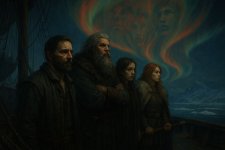
På julafton har Waverider rest norrut, långt norrut, till frusna Borealia, och det är därifrån de skickar sin julhälsning. Hittade de tomten?

20250708_1819_Aurora's Arctic Struggle_simple_compose_01jznd61m2e7q9eaphdmpk2k4h.jpg20251022_1752_Aurora's Watchful Crew_simple_compose_01k869qhgwehrbbhe11g5c00j2.jpg

Nej

The Waverider froze into the ice before winter had even begun.

One day, the sea steamed black under low sun; the next, it cracked and folded, locking the ship in white stone. By morning she was still, her hull groaning against the pressure of a living sea. The men swung axes at the ice, but the cracks they made closed again by nightfall.

When the blizzards came, Solonex ordered the crew ashore. They built camp around an abandoned whaling outpost half buried in snow, four huts, a watchtower, and the bones of a boat that had failed before them.

Forty-three souls made landfall.

They burned half the timbers for warmth.


The first month held routine. Solonex kept the log, counting rations and rotation duties. Eira charted weather patterns and the drift of the ice. Selene tended frostbite and infection. Brannick cooked, cursed, and coaxed laughter out of men who'd forgotten what it was for.

Ulfar led the hunting parties. He said the land felt hollow, that sound traveled like breath in a cave.

At night, the sky pulsed with auroras-green and blue curtains folding over the stars. At first they lifted spirits. The crew sang beneath them. Then they began to notice: the lights dimmed when voices rose, and flared brighter when they fell silent.

"The gods are listening," a sailor said.

"No," Solonex answered. "The world itself is."


By the third month, the camp had gone quiet. The aurora never left the sky. Some swore it moved closer, the colors running like ink down the horizon.

The men began seeing things in the white: movement between ridges, shadows that didn't match their own. A sentry claimed he saw someone waving from the shipwreck at dusk-one of their lost deckhands, standing barefoot on the rail, smiling.

He went himself, knowing before he looked there would be nothing. But when he returned, his boots were soaked to the ankles and steaming as if from heat, not cold.


Rations thinned. Jokes grew brittle. Brannick rationed laughter like salt.

Selene saved her herbs for frostbite and prayed over the ones she couldn't save. Eira took to sleeping by the door, saying she could hear the ice shift in rhythm with their breaths.

When Ulfar came back from the hunt, he brought meat that steamed black when cooked. He didn't say what it was, only that the snow had melted where he found it.

The aurora turned red that night, deep and slow, like the beating of a heart.


Spring didn't come. The wind softened, but the ice held fast. Two men vanished from the outer huts. No struggle, no tracks, only the doors left open. Their bunkmates said they'd gone to follow the lights.

Solonex banned anyone from leaving camp after nightfall.

That rule lasted three days.

Then the stove went out. The sky pulsed red again, and the crew swore they saw figures in the light, tall, thin, human-shaped, walking just above the snow. Some of the younger sailors ran out calling to them. They came back hours later, eyes glassy, their skin unburned by frost, their breath faintly luminous in the dark.

They said they'd found warmth, but couldn't explain how.


The rest stopped asking questions. They worked, ate, slept, in silence.

Selene kept tending wounds no longer made by accident. Ulfar hunted nothing and returned empty-handed but swore the lights led him home each time.

Eira mapped the sky, marking each flare and pulse. She said the aurora spelled their names if you watched long enough.

Brannick burned the last of the oil and called it mercy.


When the thaw finally came, it didn't feel like salvation.

The ice cracked without sound, the sea opening in slow breaths. The Waverider drifted free, hull scarred but intact. The survivors packed what was left of the camp, half of them pale as glass, eyes reflecting the colors above, not like mirrors, but like windows left open.

They left Borealia without ceremony.


On the first night back at sea, the aurora rose again, brighter than ever, following them south. The crew gathered on deck in silence.

Eira saw faces in the light, forty-three, clear as memory, drifting through the colors. Each wore the same faint smile.

Solonex stood at the bow, jaw tight. "They're not lost," he said softly. "They're watching."

No one argued.


From the captain's log, final Borealia entry:

"We held through the long night. No deaths, though I'm not sure all returned whole. The auroras move with purpose now. They mirror what we remember, or perhaps what remembers us. Either way, they will follow." - Solonex, Captain of the Waverider
 
Back
Top